

Maturity Model assessment tool

Overview

The online assessment tool provides a framework for agencies to assess evaluation skills, practices and resources at an agency, group, division or branch level.

The tool is designed to be undertaken collaboratively rather than individually to encourage discussion and reflection on evaluation skills, practices and resources.

While there is no prescribed approach to undertake the online assessment tool, it is recommended engagement across the agency to capture inputs occurs prior to conducting the assessment. This ensures results are representative of the agency’s overall evaluation mature.

Agencies are encouraged to refer to the User guide prior to commencing the assessment.

How to use the Maturity Model

The online assessment is organised into:

  • 4 domains
  • 16 dimensions
  • 30 descriptors

It measures progress against these areas using 3 maturity levels:

  • Emerging
  • Maturing
  • Embedded

The user will be asked to select the statement that best describes their agency’s evaluation maturity level under each of the 30 descriptors. These responses will inform the final assessment results.

The online tool provides options for downloading results in a PDF format, making it easy to analyse and share results. The results provide a breakdown of maturity level overall and by domain, dimension and descriptor. This assists evaluation units or coordination teams with understanding where the agency performed well and where further improvement is recommended and assist in developing an action plan.

Maturity Model assessment and action planning process

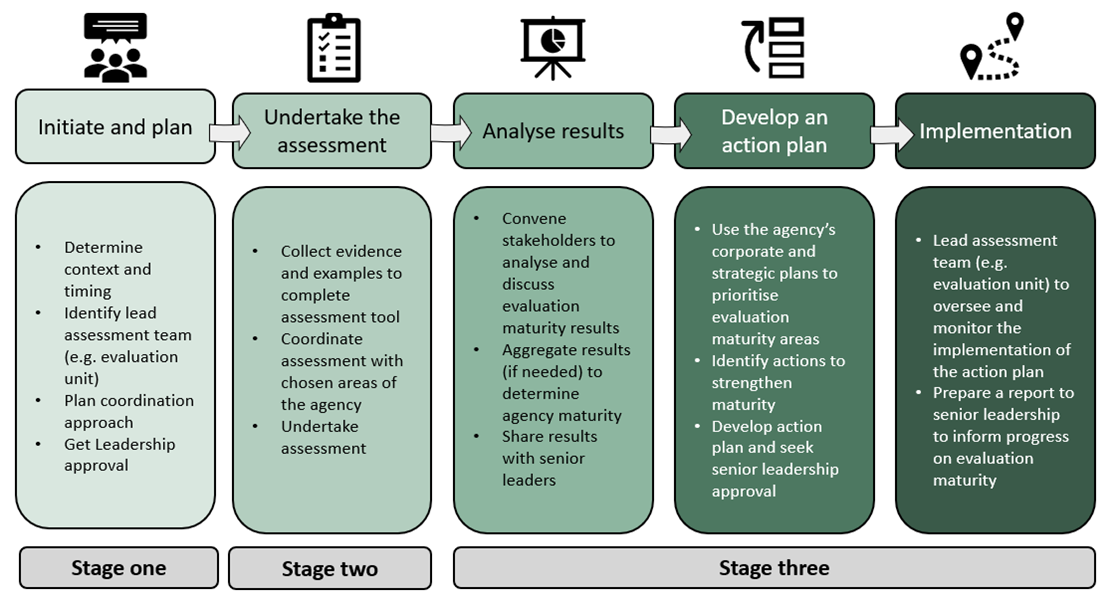
Maturity model assessment steps

This image describes the Commonwealth Evaluation Maturity Model assessment and action planning process. From left to right: initiate and plan; undertake the assessment; analyse results; develop an action plan; and implementation. 

Stage one is to Initiate and plan. This includes the following: determine context and timing; identify lead assessment team (for example, an evaluation unit); plan coordination approach; and get leadership approval.

Stage two is to Undertake the assessment. This includes the following: collect evidence and examples to complete assessment tool; coordinate assessment with chosen areas of the agency; and undertake assessment.

Stage three is to analyse results, develop an action plan and implementation. This includes the following: Convene stakeholders to analyse and discuss evaluation maturity results; aggregate results (if needed) to determine agency maturity; share results with senior leaders; use the agency’s corporate and strategic plans to prioritise evaluation maturity areas; identify actions to strengthen maturity; develop action plan and seek senior leadership approval; leader assessment team (for example, an evaluation unit) to oversee and monitor the implementation of the action plan; and prepare a report to senior leadership to inform progress on evaluation maturity.

Complete the assessment tool

Once you are at the assessment stage, follow the below steps to complete the assessment tool.

Your details

We'll never share your email with anyone else.

Privacy Statement for the Commonwealth Evaluation Maturity Model assessment tool administered by the Australian Centre for Evaluation.

This collection notice applies to users of the tool who have consented to share their contact details with the Australian Centre for Evaluation.

  1. Your personal information is protected by law, including the Privacy Act 1988 (Privacy Act) and the Australian Privacy Principles (APPs), which regulate how entities may collect, use, and disclose personal information.
  2. The Treasury is collecting your personal information, including your Government agency, Division, and email address for the purpose of providing follow up resources and support in relation to the agency evaluation maturity tool (tool).
  3. Without collecting this information, we will be unable to provide follow up resources and support.
  4. The Treasury will only use tool assessment results for reporting at the aggregate level which will not contain any personal information.
  5. The Treasury's privacy policy contains further information about how the Treasury handles personal information, including: how to access and seek correction of your personal information; how to lodge a complaint regarding the Treasury's handling of your personal information; and how the Treasury will handle such a complaint. You can also contact Privacy@Treasury.gov.au for further information.

You need to complete all the sections to calculate results.

Evaluation leadership and culture

This domain focuses on key areas an agency would expect to see to foster evaluation culture and leadership engagement on evaluation. Please select a card in each row that resonates most with how you see your current evaluation maturity.

Senior leadership engagement

Promoting learning and development

Leadership promotes evaluation

Strategy and governance

Evaluation in strategic planning

Evaluation policy or governance

Integrated planning

Linking program outcomes to performance planning/corporate reporting

Evaluation evidence used to manage risks

Evaluation capability

This domain focuses on key areas an agency would expect to see to build evaluation capability. Please select a card in each row that resonates most with how you see your current evaluation maturity.

Organisational capacity

Technical evaluation skills

Evaluation knowledge/understanding

Training and recruiting

Evaluation training/professional development

Recruiting for evaluation skills

Data systems

Relationship with data areas

Linked data access

Data knowledge and technical skills

Data knowledge and technical skills

Ethics and cultural safety

Culturally safe practices

Knowledge of ethical research protocols

Evaluation design, planning and delivery

This domain focuses on key areas an agency would expect to see for evaluation design and delivery. Please select a card in each row that resonates most with how you see your current evaluation maturity.

Prioritisation

Evaluation as a business priority

Using evaluation to govern the effectiveness of policies, programs and services

Planning and Delivery

Evaluation planning

Evaluation delivery

Evaluation methods

Evaluation technical expertise and evaluation methods

Evaluation methodology and approach

Resourcing

Evaluation resources

Evaluation funding/budget

Evaluation use

This domain focuses on key areas an agency would expect to see as an agency strengthens its use of evaluation evidence. Please select a card in each row that resonates most with how you see your current evaluation maturity.

Design

Program logic/theory of change are built into design processes

Use of evaluation results for design

Decision making

Use of evaluation evidence for decision making

Availability of evidence for decision making

Access to evaluation evidence

Internal access to evaluation evidence

Publication of evaluation evidence

External engagement

External engagement and partnerships

Back to top